|
|
🇮🇹La Newsletter Italiana
by Sandro 'Sandrino' Cuccia
For Students and Instructors
of the Italian Language
at the
Osher Lifelong Learning Institute
University of Delaware
| |
|
Il Tricolore – Are we talking about
a FLAG or a MILITARY AIRCRAFT?
Plus... IL GIORNO DELLA MAMMA!
| |
|
Buongiorno, e BUONA FESTA DELLA MAMMA!
[HAPPY MOTHER'S DAY]
Tanti auguri per una buona festa della mamma a tutti i lettori della 🇮🇹LA NEWSLETTER ITALIANA ... a tutte le mamme!
[Best wishes for a Happy Mother's Day to all my readers ... to all the moms!]
Before starting our topic for today, here are a few popular Italian expressions honoring LA MAMMA...
Una buona mamma vale cento maestre.
[A good mother is worth a hundred teachers.]
Amor di madre, amore senza limiti.
[A mother’s love has no limits.]
Chi è buona madre è anche buona moglie.
[A good mother is also a good wife.]
Ognun dà pane ma non come mamma.
[Everyone gives bread but none does it like a mother.]
Mamma mia sempre, ricca o povera che tu sia.
[My mother forever, no matter how rich or poor.]
Tre figlie e una madre, quattro diavoli per un padre.
[Three daughters and a mother, four devils for the father.]
Who says Italians have no sense of humor?!
| |
|
IL TRICOLORE:
The GREEN, WHITE, RED
Flag of Italia
🇮🇹🇮🇹🇮🇹
| |
|
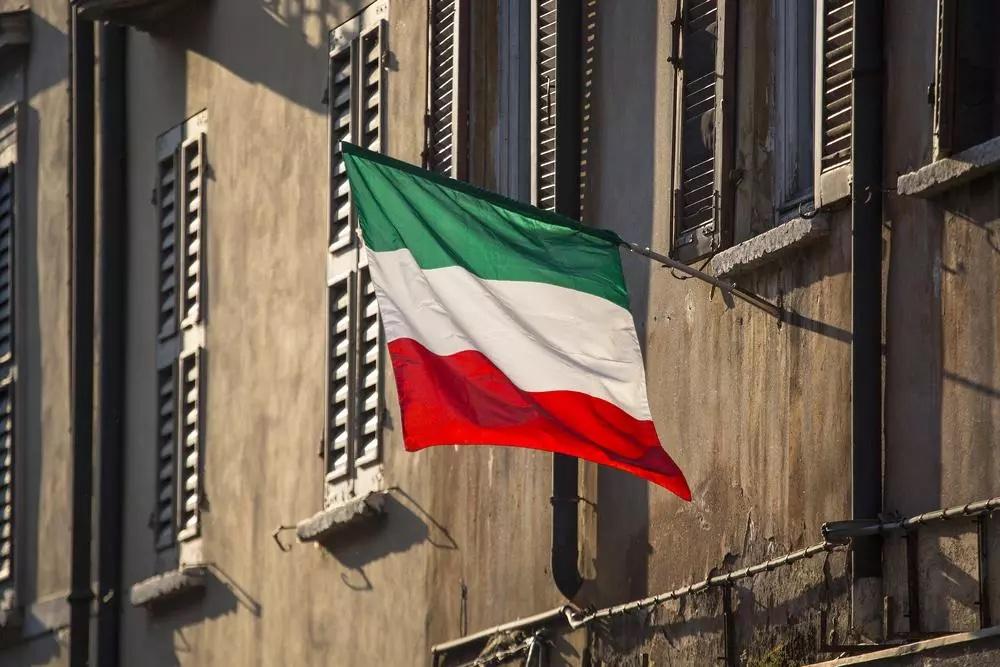
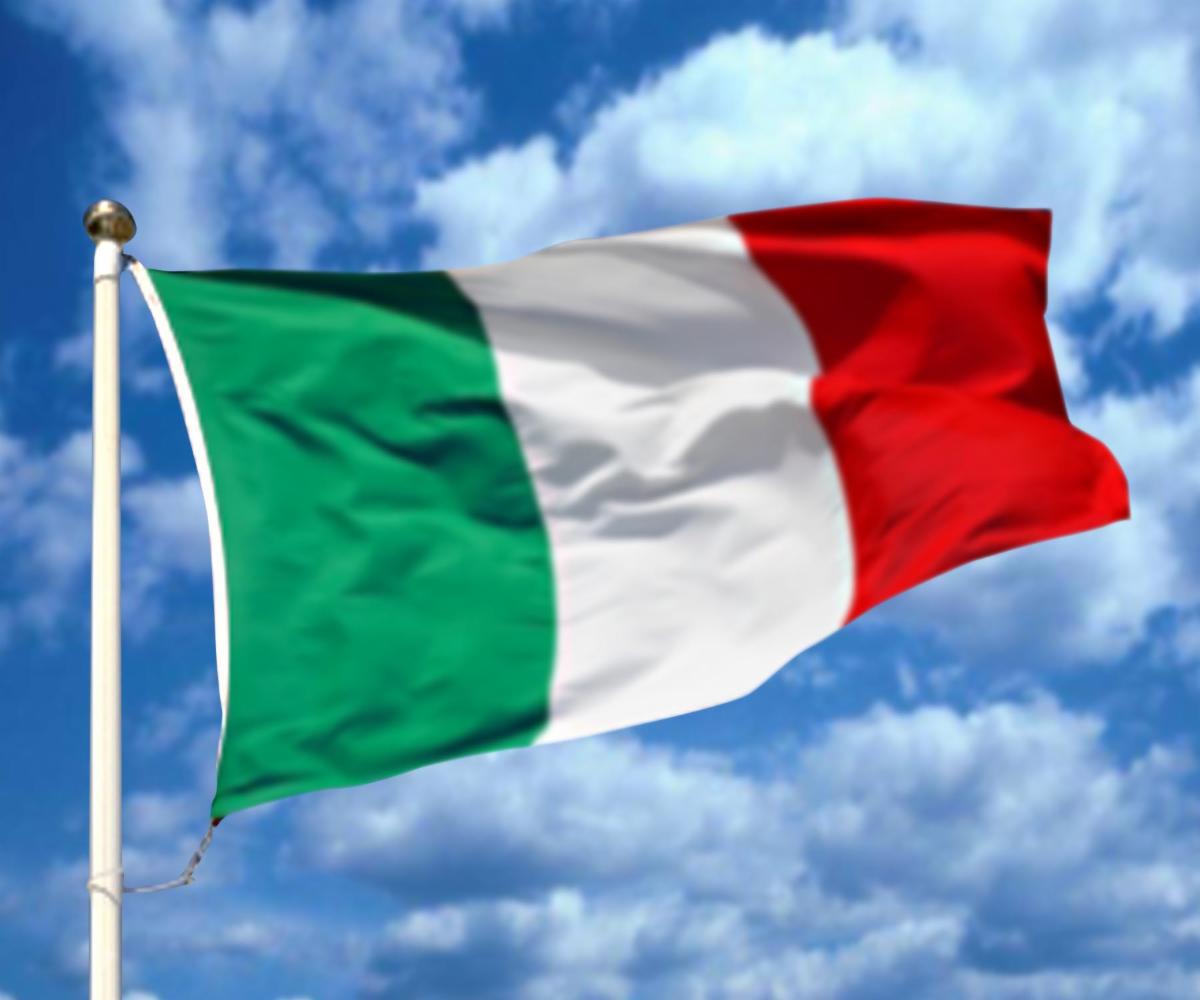
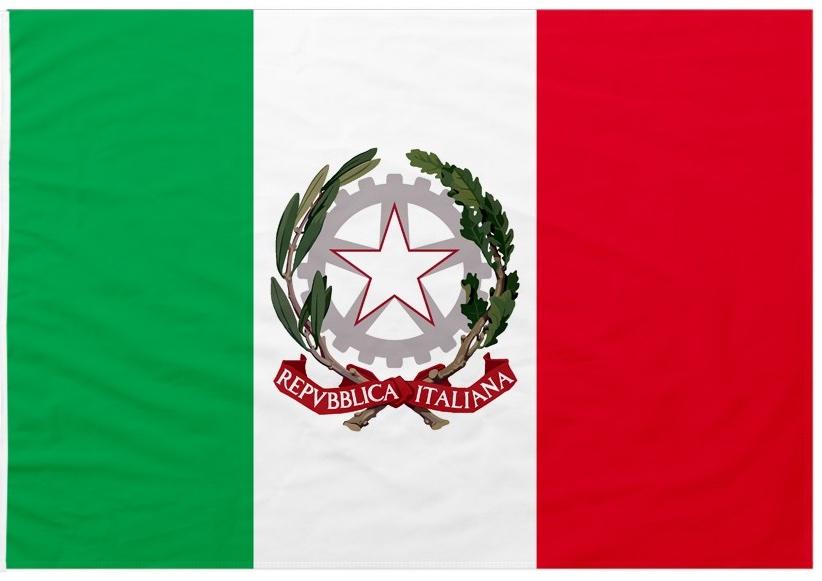
La bandiera italiana - chiamata “Il Tricolore” - è una delle bandiere più riconoscibili al mondo.
[The Italian flag, called “Il Tricolore” (three-colors) is one of the most recognizable flags in the world.]
With its trio of VERDE, BIANCO e ROSSO [green, white, and red] splashed across 'Italian Restaurant' signs all over the world and printed on le magliette [T-shirts] in tourist kiosks across the country, il Tricolore è un simbolo importante dell’Italia stessa e della sua cultura. [the Italian flag is an icon of Italia itself and the Italian culture.]
| |
|
Le origini della bandiera italiana
[The origins of the Italian flag]
Did you know that the vertical stripes of green, white, and red weren’t always synonymous with Italia? So... where do the colors come from, and do they signify anything?
You francophiles are gonna love this! ...
The Italian flag 🇮🇹 was originally designed under Napoleon's rule, and was heavily influenced by another 'Tricolore' -- yes... the French flag 🇫🇷, introduced by the revolution in 1790 on French Navy warships.
The origins and details of the development and acceptance of il Tricolore is enormous in scope and complexity. Though the national Italian flag would go through many different iterations before becoming what it is today, the colors green, white, and red have been a recurring pattern throughout its history. Nevertheless, there is no clear answer to what the symbolism is behind the three colors.
But of course, there are multiple theories regarding Italia's Tricolore.
One theory is that the colors carry idealistic significance:
Il VERDE significa libertà,
il BIANCO: la fede,
il ROSSO: l’amore.
[GREEN: freedom, WHITE: faith and purity, RED: love.]
Another theory is that the colors represent Italia's geographical landscape and history: GREEN for the countryside, WHITE for the snowy Alps, and RED for the blood of the Italian people that was shed over the course of Italia's history.
Personally, I side with a third popular belief that the colors have religious significance, representing the three theological virtues:
il VERDE: la speranza,
il BIANCO: la fede,
il ROSSO: la carità.
[GREEN: hope, WHITE: faith, RED: charity.]
| |
|
Da quanto tempo esiste la bandiera italiana?
[How long has the Italian flag existed?]
The Italian flag precedes Italia's unification in 1861. Prior to unification, each republic (i.e. city-state) in Italia had a different flag. When Napoleon began conquering Italian states after the French Revolution began in 1789, he changed the landscape of Italia, creating new republics and destroying former territories.
Following France’s call for national unity, many Italians formed political and military groups to focus efforts on creating unity within their republics.
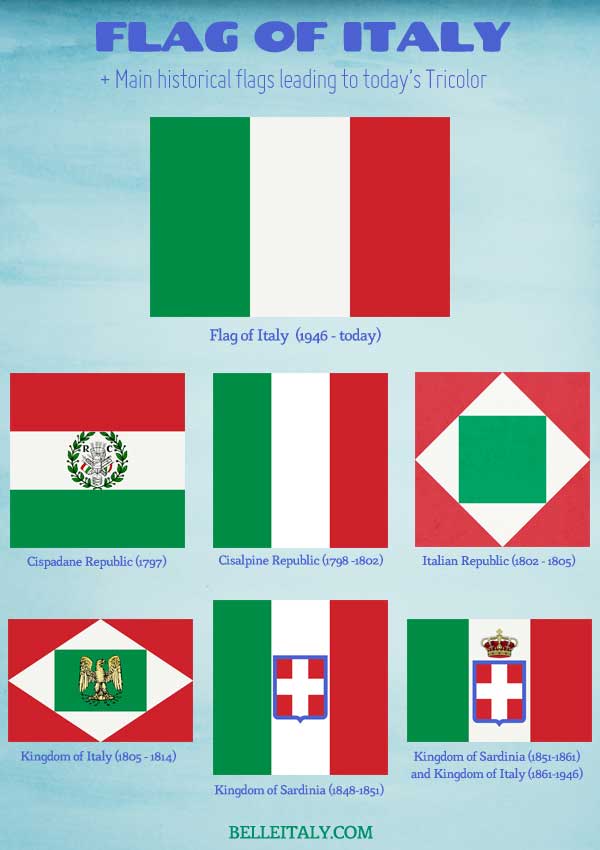
The colors green, white, and red were originally taken from the civic militia in the Transpadana Republic, an unofficial government based in Milano. Militia members wore these colors on their uniforms. In 1797, the Cispadana Republic in Modena, established by Napoleon, designed its flag with the trio of colors in horizontal stripes and a central emblem.
As the Cispadana Republic grew and evolved the stripes were rotated counterclockwise to the vertical stripes they are today, with green on the left (hoist-side), white in the middle, and red on the right.
| |
|
Quando è apparsa la bandiera ufficiale d'Italia?
[When did the official flag of Italia first appear?]
From 1798 to 1848, the Tricolore was an unofficial symbol of ununified Italian nationalism. When Napoleon’s rule ended in 1814, a new chapter of Italian history began. Italia was geographically united as one country in 1848, and the Tricolore became a celebrated symbol of Italia.
Many regions began adopting flags that reflected elements of the Tricolore, adding to a sense of national unity. On 23 March 1848, the flag was used by Italian troops in battle against the Austrian army, making it an official symbol of Italian confederation.
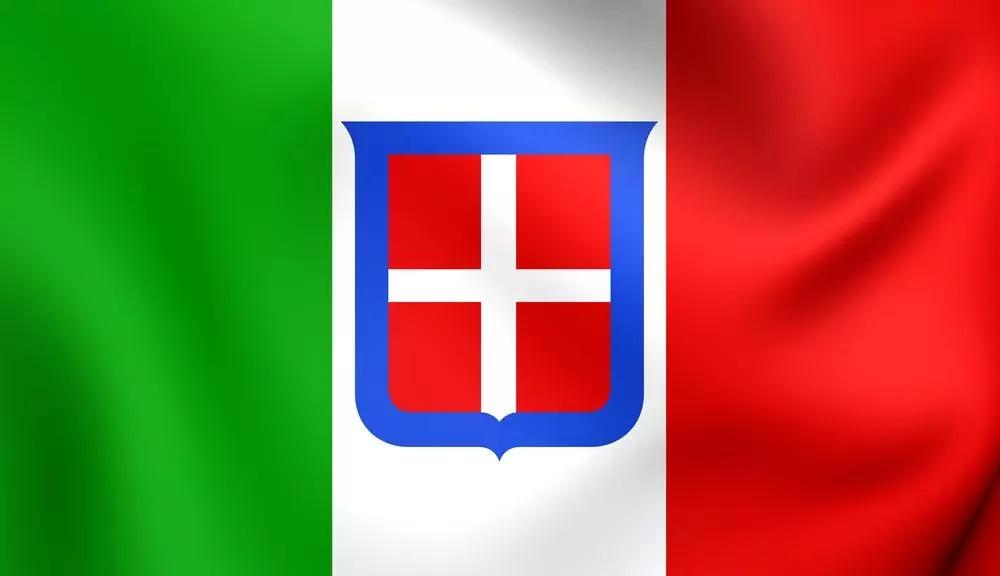
In 1861, it became the official flag of the Regno d'Italia [Kingdom of Italy].
When Italia was officially united as a monarchy under the rule of the Royal House of Savoy in 1861, a shield, cross, and crown were added to the center of the flag’s three stripes.
| |
|
Come viene usata la bandiera d'Italia?
What is the flag of Italy used for?
As well as being a symbol of national unity and pride, the Italian flag is a cherished symbol of Italia's history and the complicated road to becoming the Italian Republic.
As in many countries, it is illegal to desecrate or otherwise disrespect the Italian flag. Any form of abuse is considered a crime, and perpetrators risk being fined up to 5000 euro and/or possible imprisonment.
The Italian flag can be seen hanging outside of government buildings or being flown on holidays and ceremonial occasions of national importance.
La Festa del Tricolore, ufficialmente Giornata Nazionale della Bandiera, o Giornata Tricolore, è una giornata celebrativa nazionale italiana, istituita per ricordare la nascita della bandiera d'Italia.
[The 'Feast of il Tricolore', also known as the 'National Flag Day' or the 'Tricolore Day', is a national day of celebration, established to remember the birth of Italia's flag.]
Si festeggia ogni anno il 7 gennaio, con le celebrazioni ufficiali che avvengono a Reggio Emilia, città dove venne approvata per la prima volta l'adozione del Tricolore da parte di uno Stato italiano sovrano, la Repubblica Cispadana.
[It is celebrated every year on January 7, with official festivities which happen in Reggio Emilia, the city where the Tricolore was first adopted by a sovereign Italian state - the Repubblica Cispadana.]
| |
|
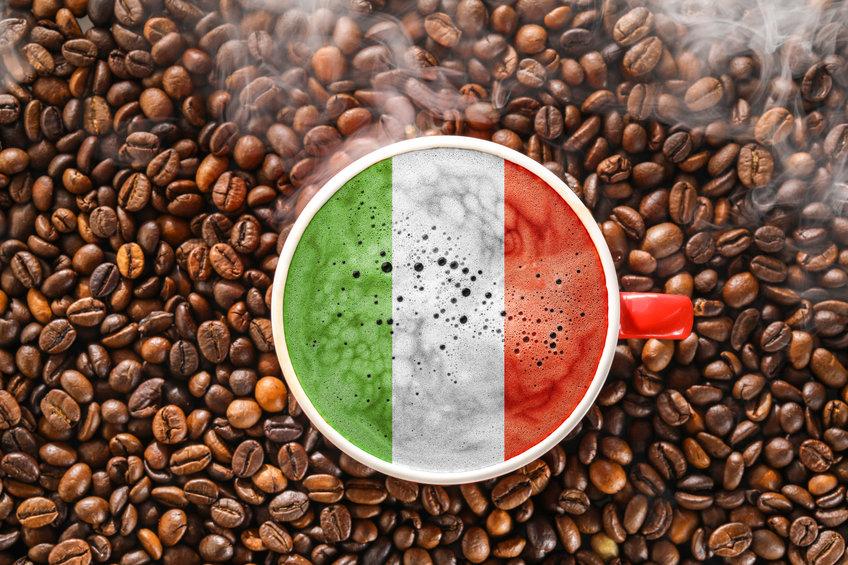
È ARRIVATA l'ORA DI PRENDERCI UN CAFFÈ
mentre pensiamo al significato del Tricolore!
[It's time for us to have some caffè
while we reflect on the significance of the Tricolore!]
| |
|
Le FRECCE TRICOLORI
rappresentano l'amata bandiera d'Italia
The Tricolor 'Arrows'
represent the beloved flag of Italia
| |
|
In a previous issue of 🇮🇹 LA NEWSLETTER ITALIANA, and certainly in all my Italian classes, I have brought up Le Frecce Tricolori [the tri-colored arrows] as a point of discussion.
You may be thinking...
"Di che diavolo sta parlando Sandrino?"
["What the heck is Sandrino talking about?"]
(By the way, it's good to see the you are starting to think in Italian!! BRAVO!!)
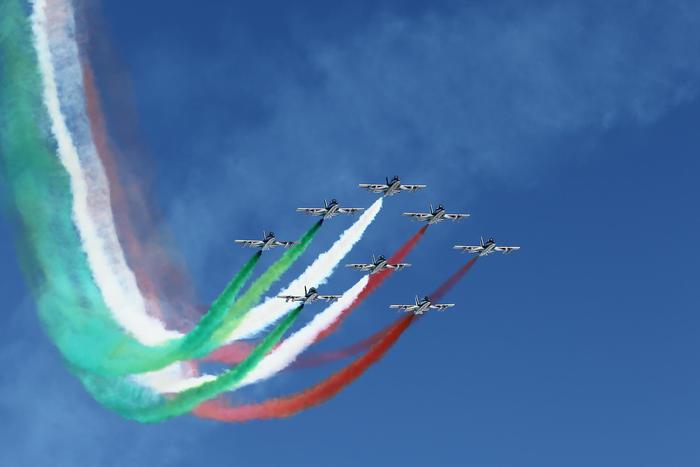
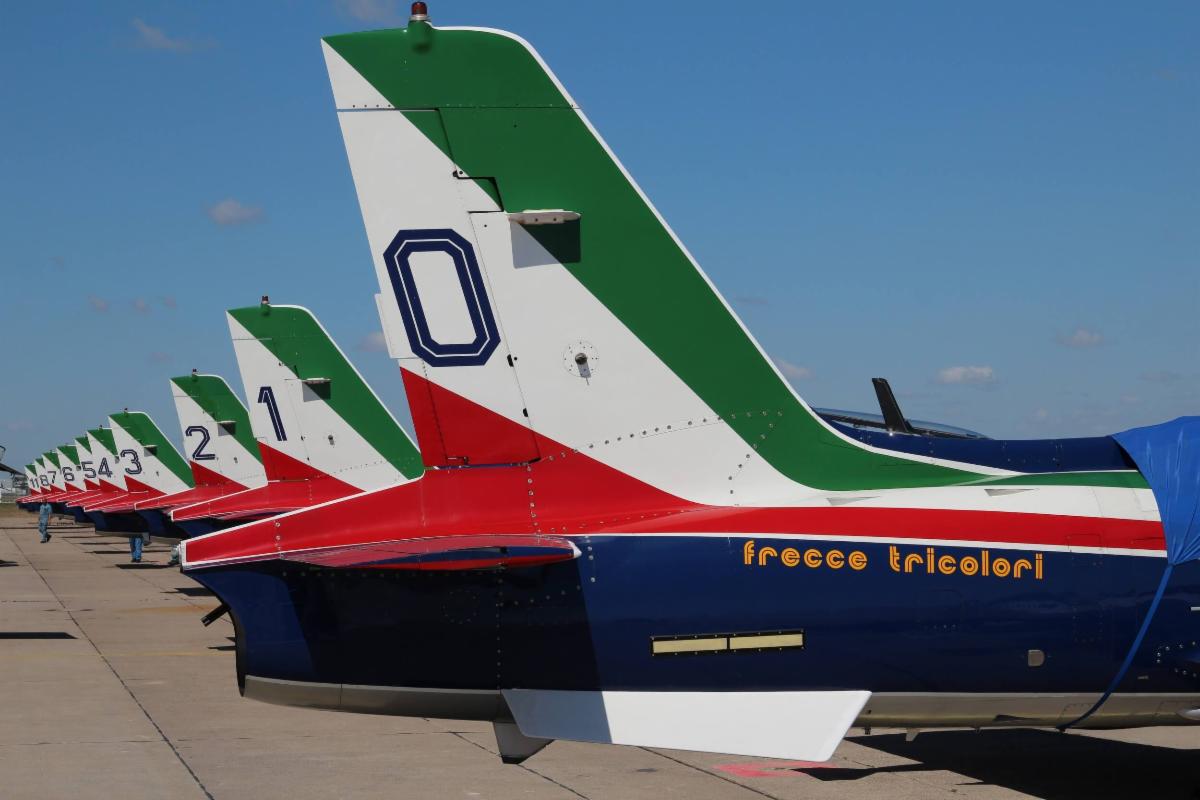
Le Frecce Tricolori is the name given to a team of small aerobatic jet aircraft - part of La Aeronautica Militare Italiana [the Italian military air force]. This team puts on mozzafiato [breathtaking] aerobatic displays throughout Italia and nearby countries. These aerobatic displays are used for many special national occasions and celebrations.
During the recent COVID-19 pandemic in Italia and the devastation that it produced, particularly in the northern regions, Le Frecce Tricolori air-displays were instrumental in lifting the national spirit of all Italians during lockdown and an uncertain future.
Le Frecce Tricolori sorvolano le città italiane in un virtuale abbraccio in memoria delle vittime di COVID-19.
[The Frecce Tricolori fly over Italian cities in a virtual embrace in memory of the victims of COVID-19.]
| |
|
During its almost 60 years of existence, Le Frecce Tricolori, with their green, white and red contrails, have often been called to highlight a number of significant moments in the history Italia. This tradition brought Italians to consider this national aerobatic “patrol” as one of the many important symbols of country's history.
The highly-trained pilots within this group of dedicated flyers are very much aware that they sustain the weight of responsibility for the role they are assigned. They frequently talk of being filled with pride, as this activity gives them the opportunity to be custodians of a heritage that represents every Italian.
Le Frecce Tricolori are one of Italia’s national symbols. Among others, they are the 2nd of June (feast of the Italian Republic), the 4th of November (National Unity and Armed Forces Day), the Altare della Patria (Altar of the Fatherland - the name given to the Victor Emanuel II monument in Roma), and Italia’s flag sketched in the three colors high up in the sky. They represent the Inno di Mameli (the Italian national anthem, also known as “Il Canto degli Italiani” - "Song of the Italians") – the most patriotic sentiments of all Italians.
The Frecce aerobatic demonstration team consists of ten aircraft – nine in close formation plus a solo flyer. The team makes up the world's largest aerobatics pattuglia [patrol].
Each demonstration consists of about twenty aerobatic displays and lasts about thirty minutes. Most performances end with a grand-finale, as the aircraft draw a five kilometer-long green, white and red flag of Italia in the sky. As the jets roar above, spectators on the ground can hear public-address speakers, simultaneously and in-sync, blare out the voice of Luciano Pavarotti singing the bombastic finale of Nessun Dorma, also known as Vincerò [“I will win”] from Turandot by Giacomo Puccini.
This is enough to give me, and all other Italians world-wide, unforgettable shivers of pride!!
Given the awesomeness of their performances, the skills and dedication of the pilots, and the shear importance of their mission, over time, Le Frecce Tricolori have become the most famous military aerobatic team in the world.
While it is unlikely we'll ever see a stunning performance of Le Frecce Tricolori here in the U.S., you can see many examples in videos posted on YouTube – such as the one posted below – by simply doing a search for 'Frecce Tricolori' directly within YouTube.
(Aspetta... [wait...] on second thought, couldn't they load the team of Frecce Tricolori onto an aircraft carrier and come for a little visit over here? Just sayin'...)
Spero che questo video piaccia a tutti i miei lettori!
[I hope all my readers enjoy this short video!]
|  | |
|
🇮🇹 LE FRECCE TRICOLORI 🇮🇹
accompagnati dalla la voce di Luciano Pavarotti
| |
|
Ci rivedremo presto nel prossimo numero della nostra bellissima 🇮🇹Newsletter Italiana!
[We'll meet again in the next issue of our beautiful 🇮🇹Newsletter Italiana!]
Per adesso, vi do un caloroso CIAO-CIAO!
| |
🇮🇹La Newsletter Italiana
is written and published by
Sandro "Sandrino" Cuccia
sandrino@hey.com
| | | | | |